

The rapid and far-reaching transformations being observed in technology, robotics, communications, climate change, and others, are radically bringing about unprecedented consequences on how the future of work might look like in the coming years. The increasing growth in intangibles and the need to transition towards a sustainable economy urges not just the government and international organizations to act accordingly, but every one of us to re-think a more pragmatic approach in confronting these issues and anticipate future demands in a way that will prevent mass harm and disruption to our societies.
The Rise in Intangible Assets
Acknowledging the growing rise of the digital economy and the increasing development of computing power, the loop for shifting investments towards intangible assets has become an increasingly common trend within the past decade. Intangible assets stand as the most important element for future economic growth, business models and emerging markets alike. Intangible assets are non-physical properties that have the ability to create value without the need of being physically present nor materialised. More precisely, intangibles assets can be observed in the process of designing products and marketing material, which involves paying designers & business analysts; in research and development (R&D), which involves paying scientist to develop more efficient models; in software and computer engineering, which involves paying developers to program complex codes and effective algorithms; and in a variety of other digital services and products which contribute largely to the growth of the digital economy (Haskel and Westlake, 2017).
As automation and labour-saving equipment becomes more useful and efficient for producers, labour-intensive services become more expensive relative to manufactured goods over time. In other words, most tangible investments are manufactured and require material resources, whereas intangible investments rely purely on labour and do not require manufacturing. This does not mean that tangible products do not involve labour, but as technology and innovation continues to develop, over time, intangibles investments will radically rise in value and price relative to tangibles.
This trend has the potential to affect not just financial growth, but the possibility to transition towards a sustainable, green and digital economy. Diving into these changes too fast, however, may also cause substantial harm and leave many of us behind. Promoting automation and steady growth in intangibles, will have a massive impact on employment and the future labour market. Ensuring societies are equipped with the skillset and required capabilities of the 21st century is fundamental.
Employment Impact on Industries
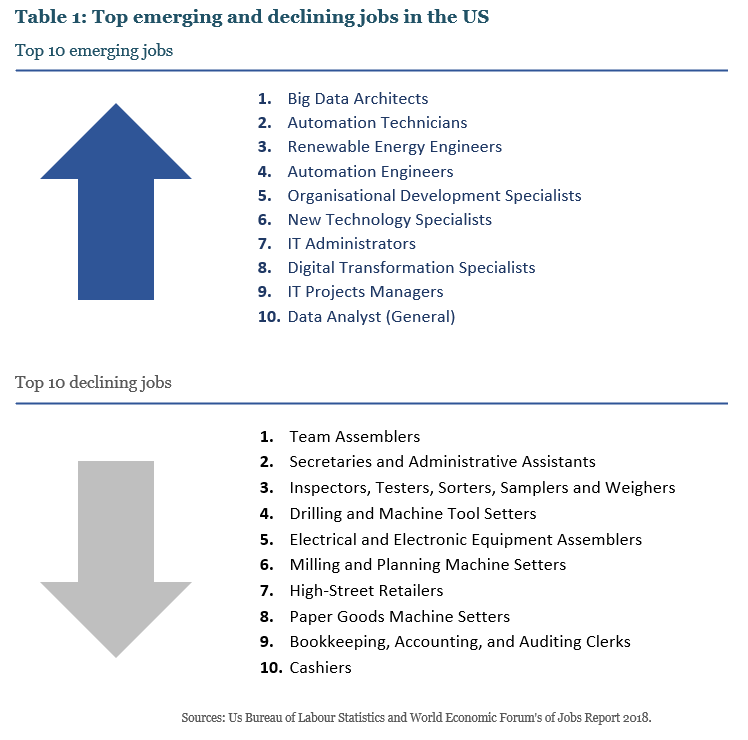
According to the World Economic Forum (WEF) report on Towards a Reskilling Revolution, current trends could lead to a net employment impact of more than 5 million jobs lost due to disruptive labour market changes and automation over the period of 2021–2026. The biggest employment decline of any job family is expected to be in Office and Administrative roles, which are expected to suffer a negative transformation due to the increasing storm of technological developments that have the potential to make them redundant. On the other hand, the strongest employment growth sector is expected to come from the Computer and Mathematical job family. The rapid urbanisation and the increasing growth of Big Data analytics, the Internet of Things (IoT), e-commerce, online shopping & cloud technology are exponentially shifting the workforce to specialise in producing these intangible developments, as the majority of tangibles can be done autonomously by a machine – or are likely to be done that way in the near future. Understanding and predicting the knowledge and decisions of an individual will become the fundamental attraction for businesses. Acting upon insights from customer data and preferences to provide a more personalised shopping experience will arguably be more valuable for companies than recruiting new employees to assist them with tasks that require manual processing. On the governmental side, identifying citizen needs by harnessing public databases to target specific demands more precisely, will help in anticipating future disruptions and solving the job crisis of the digital age. The top emerging and declining jobs in the US shown in (Table 1), gives a hindsight on the direction of where employment demands are likely to rise and fall in the coming years.
The Challenges of Public Administration Officials
Policymakers and legislators are often buried with large volumes of data and tough societal problems. Their critical functions require them to digest complex information, charts and data visualisations into actionable and valuable insights, which are most commonly hard to interpret and difficult to implement. Technical, complex and profound analysis makes it troublesome for decision-makers to understand what has to be accomplished. It is the reason why data scientist, consultants and analysts come in to play – they have the ability to supply information in a simple manner and incline policymakers towards their argument (Kettl, 2017; Chapter 4). Elaborating a good story is as critically important as collecting data and evidence. Presenting data in a way that connects with real values and context-based problems has the power to influence government officials and policy implementations alike. Ensuring we agglomerate a diversified set of skills and professions in the policy-making process will provide a more optimized and customized data-driven and evidence-based approach to the enormous challenges legislators face when tackling societal problems.
What can be done?
As we have observed, the future of labour demands shifting markets and skills towards intangible production, as foreseeing upcoming problems and growth opportunities requires evaluating the current economic infrastructure and financial landscape. Analysing the direction of investments and employment gaps will enable governments to forecast and anticipate future market failures. If a large percentage of investments are concentrated in a certain industry (i.e. technology and software), it means that IT & infrastructure will experience significant growth relative to other industries, and subsequently more employment opportunities. Governments must deliver and unleash smart job incentives that would foster labour-intensive skills, which would match the skill set required for the future. Creating opportunities for good jobs that leverage those skills that have low susceptibility to automation (i.e. social skills; emotional intelligence; teaching; cognitive abilities; creativity & mathematical reasoning; critical thinking & problem solving) will ensure that less people get left behind. This requires not just transforming ordinary industries, but most importantly, boosting the digital skills that will empower the workers of the future. This includes rethinking education systems and offering the necessary training since early ages.
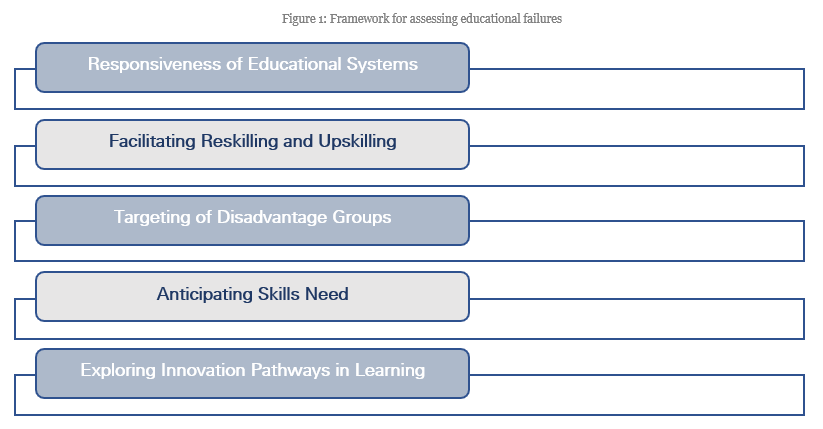
An effective approach would be to leverage some sort of framework that can assess educational failures and construct policy initiatives (see Figure 1). A starting point would be to evaluate the educational system and its responsiveness to address current demands, to then adapt and facilitate education with better practices. Targeting disadvantage groups and anticipating the skills of the future with models that provide data-driven evidence would be fundamental to ensure no one gets left behind and that individuals can actually study a set of skills that would benefit them in the future labour market. Additionally, exploring new and innovative pathways of learning will enable discovering more efficient and dynamic mechanisms of study, resulting in better and more entertaining ways of gaining the necessary skills.
According to the Organisation for Economic Co-operation and Development (OECD), an estimate of 65% of children entering primary schools today will ultimately work in new job types and functions that currently do not exist. Therefore, as we embed in our transition towards a sustainable and digital economy, government and policy-makers have an important role in advocating and creating the necessary incentives for anticipating the upcoming labour market and for shifting the direction of workers respective to the future investment scenario. Incentivizing lifelong learning will be fundamental along with cross-industry and public-private coordination. Empowering and identifying these gaps will require data scientist and consultants to assist legislators with analysis that support investment programmes and policies that can upskill individuals with the necessary techniques while ensuring no one gets left behind.
References:
Haskel, J. and Westlake, S., 2017. Capitalism without Capital: The Rise of the Intangible Economy. 1st ed. London: Princeton University Press.
World Economic Forum, 2016. The Future of Jobs: Employment, Skills and the Workforce Strategy for the Fourth Industrial Revolution. [online]
World Economic Forum & The Boston Consulting Group, 2018. Towards a Reskilling Revolution: A Future of Jobs for All. [online]
Kettl, D., 2017. Little Bites of Big Data for Public Policy. 1st ed. London: SAGE Publications, pp.49 – 65.
US Bureau of Labour Statistics, 2018. Employment Statistics. US Bureau of Labour Statistics.
Van der Voort, H., Klievink, A., Arnaboldi, M. and Meijer, A., 2019. Rationality and politics of algorithms. Will the promise of big data survive the dynamics of public decision making?. Government Information Quarterly, 36(1), pp.27-38.